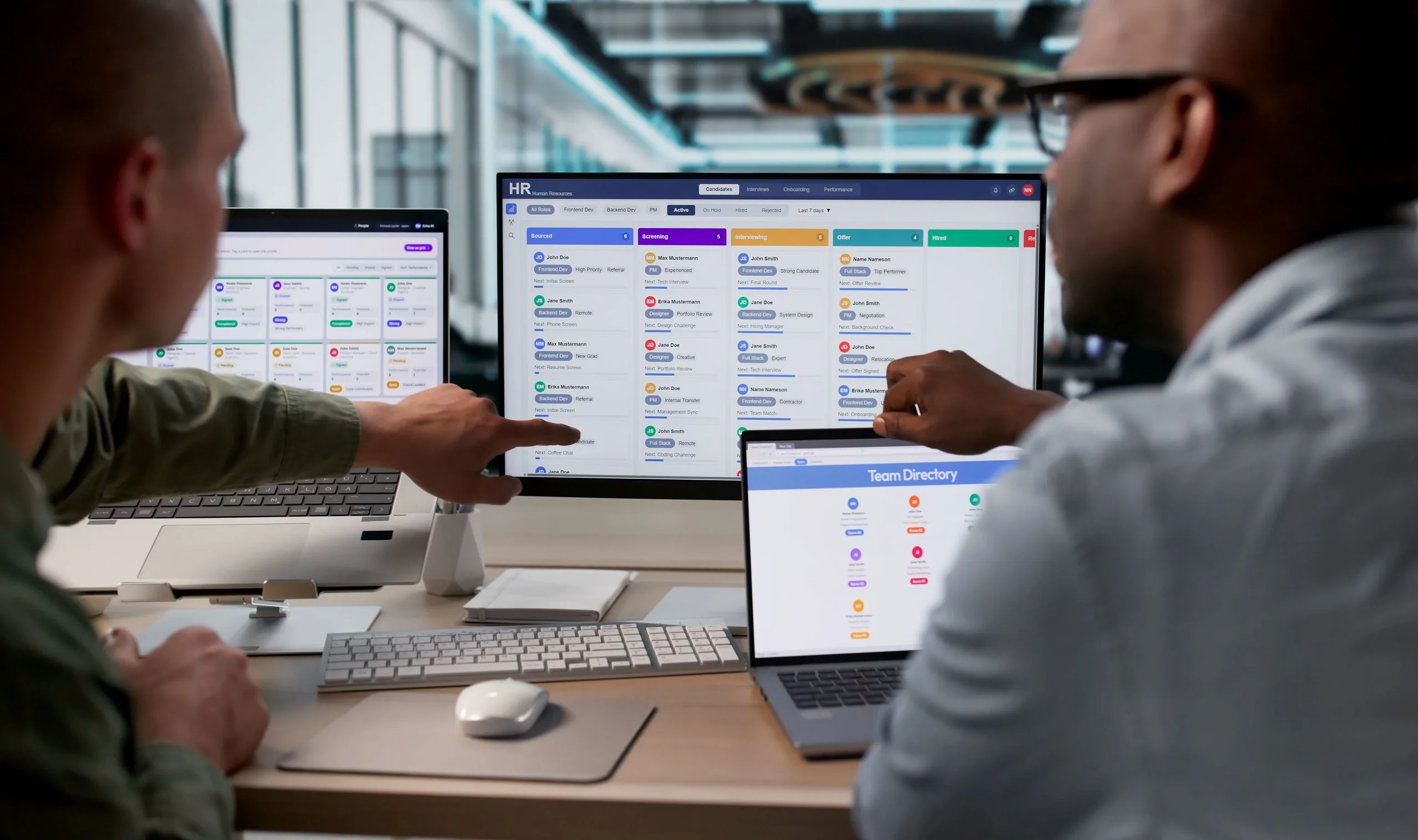
AI at Work: How Artificial Intelligence Is Improving Business Workflows and Processes

Artificial intelligence (AI) is moving from something businesses experiment with to something that can help with everyday work. Increasingly, the shift has moved from questioning AI’s place in business to a more useful one: solving real problems.
The distinction matters. AI should not be treated as valuable simply because it is new. Its value comes from helping people complete work more efficiently, find information more easily, reduce repetitive tasks, and make better use of the information a business already has.
Recent research from the Inter-American Development Bank (IDB) shows that AI adoption is growing across Latin America and the Caribbean, but the benefits are not being realised equally. The IDB notes that many firms are using AI tools, while a much smaller share reports significant economic benefits. It points to a key reason: businesses need to change how work is organised and bring AI into their core operations to see meaningful results. (Inter-American Development Bank [IDB], 2026). [Inter-American Development Bank – Will AI Boost Productivity—or Widen Inequality?]
For Caribbean businesses considering artificial intelligence, this provides an important starting point: do not begin with the technology. Begin with the work.
What Can AI Actually Do for a Business?
AI can support many of the tasks employees already perform every day. It can help sort information, summarise documents, identify patterns, answer common questions, prepare first drafts, organise data, and support routine decisions.
These capabilities can become part of an AI business workflow, where technology helps with one or more steps in a process. At the same time, employees remain involved where judgement and oversight are needed. IBM (2026) describes AI workflow automation as using AI to automate, coordinate or improve activities within an organisation, either independently or alongside employees. [IBM – AI Workflow]
Consider a common business process: handling incoming customer requests. Instead of an employee manually reviewing every request, an AI system could classify the request, identify the required information, and direct it to the appropriate team. Employees can then focus on resolving the issue rather than sorting every request from the beginning.
The same principle can apply to finance, human resources, customer service, operations, reporting, and document management.
What Business Processes Can AI Automate?
The best opportunities for AI automation are often found in repetitive work that follows a reasonably consistent pattern.
Businesses can consider AI for tasks such as:
- Sorting and classifying documents
- Extracting information from forms
- Preparing routine reports
- Organising customer enquiries
- Searching large amounts of business information
- Summarising meetings or documents
- Supporting invoice and expense processing
- Responding to frequently asked questions
- Identifying unusual patterns in business data
- Assisting employees with routine administrative work
This does not mean every task has to be automated. A process may still require human review, particularly when it involves sensitive information, financial decisions, customers, or employees.
The goal is to identify where technology can remove unnecessary manual effort while keeping people responsible for important decisions.
How Does Artificial Intelligence Improve Productivity?
This area is sensitive because it relates to how productive employees will be alongside AI tools. Productivity is not only about getting more work done. It is also about making better use of the time, skills, and resources a business already has.
Research from McKinsey (2024) has found that generative AI has applications across corporate functions, including finance, human resources, and customer care, with organisations increasingly moving from experimentation to real use cases. [McKinsey & Company – Gen AI in Corporate Functions].
For employees, one of the clearest opportunities is reducing time spent on repetitive administrative work.
For an employee who spends several hours each week gathering information from different systems and preparing a routine report, that Technology can bring that information together and prepare an initial version of the report; the employee can then spend more time reviewing the results, identifying issues, and acting on the information.
That is where business process automation becomes valuable. The objective is not simply to make a task faster. It is to improve how the entire process works.
Can AI Reduce Repetitive Administrative Work?
Yes, but the biggest benefit often comes from combining AI with a well-designed business process.
Automating one small task may save a few minutes. Connecting several related tasks can have a much greater effect.
An employee onboarding process may involve collecting information, checking documents, creating records, sending communications, and notifying different departments. AI and other forms of automation can assist with several of these steps, reducing the amount of manual coordination required.
This is particularly relevant for businesses managing large teams, multiple locations, or high volumes of transactions.
MC Systems’ approach to Enterprise Software Development reflects this broader view. Its solutions are designed around an organisation’s specific needs, with AI and automated tools used across software development, testing, data work, and business applications. [MC Systems – Enterprise Software Development]
The important point is that AI does not have to sit separately from the systems employees already use. It can become part of the workflow.
How Can Businesses Use AI Without Replacing Employees?
One of the most important considerations for business leaders is how AI will affect their teams.
AI can support employees rather than remove jobs. Technology can assist with repetitive, time-consuming, or heavily administrative tasks, allowing employees to spend more time on work that requires judgement, communication, problem-solving, and customer interaction.
The World Bank (2025) estimates that 30–40% of jobs in Latin America and the Caribbean are exposed in some way to generative AI, while 8–12% could experience productivity gains from using it. At the same time, the report highlights the importance of digital infrastructure in determining whether workers can benefit from AI. (World Bank, 2025). [World Bank – Quantifying the Jobs Potential of AI in Latin America and the Caribbean]
For Caribbean businesses, this means AI adoption should include people, not just technology. Employees need to understand how new tools affect their responsibilities, what information they can use with them, and when human review is required.
Why Infrastructure Matters to AI
AI applications depend on reliable systems, data, and access. If the underlying technology cannot support the workload, the business may struggle to get consistent results.
This is where cloud and hybrid infrastructure can support an AI strategy.
MC Systems provides cloud, hybrid and on-premises infrastructure options designed around business requirements. Our services include cloud solutions, data centre modernisation, networking, disaster recovery, and business continuity. The company also focuses on security, availability, scalability, and cost efficiency. [MC Systems – Cloud & Hybrid Infrastructure]
This matters because AI is not an isolated application. It can depend on the business’s existing data, systems, and infrastructure.
The IDB’s 2026 study on AI in Latin America and the Caribbean identifies data generation, storage, processing, transport and development environments as important infrastructure requirements for AI, alongside cybersecurity, data governance and skilled people. (Farca et al., 2026). [IDB – Development and Use of Artificial Intelligence in Latin America and the Caribbean].
In practical terms, businesses need to consider where their information is stored, how systems connect, who can access information, and whether their infrastructure can support increased demand.
AI in the Caribbean: Start with Practical Business Needs
AI adoption in the Caribbean is gaining attention. In July 2026, the Caribbean Telecommunications Union, UWI and the Artificial Intelligence Innovation Centre held the first Caribbean Artificial Intelligence Forum under the theme “AI for Caribbean Transformation: Governance, Innovation and Resilience for a Shared Digital Future.” (CARICOM, 2026). [CARICOM – Caribbean Charts a United Course for Artificial Intelligence]
The regional conversation is therefore moving beyond whether AI matters and toward how it can be used responsibly and effectively.
For businesses, that means looking for practical opportunities.
A manufacturing company may use AI to improve production information and identify patterns. A financial institution may use it to support customer service, information management, or decision-making. A government agency may use it to help organise information and improve service delivery.
The starting point is different for every organisation.
What Should Businesses Consider Before Adopting AI?
Before investing in AI solutions for businesses, leaders should ask a few straightforward questions:
What problem are we trying to solve?
A clear business problem provides a better starting point than adopting AI simply because it is available.
How is the process handled today?
Document the current steps, people involved, information used, and common delays.
Where is the repetitive work?
Look for tasks that consume time without requiring significant human judgement.
What information will AI use?
Businesses should understand what data is involved and who should have access to it.
Where is human review required?
Not every decision should be left to a system. Employees should remain responsible for decisions where judgement, accountability, or sensitivity matters.
Can our existing infrastructure support it?
AI may require reliable storage, connectivity, computing resources, and security.
Responsible use also matters. The National Institute of Standards and Technology (NIST, 2023) recommends considering characteristics such as reliability, security, transparency, privacy and fairness when organisations design, deploy and use AI systems. [NIST – AI Risk Management Framework]
Turning AI Into Business Value
AI can help businesses reduce repetitive work, improve access to information and support employees, but meaningful results require more than adding an AI tool.
The process itself may need to change.
That is why MC Systems brings together Enterprise Software Development and Cloud & Hybrid Infrastructure. Businesses can develop software around their specific processes while ensuring the underlying environment supports their systems, information, and future requirements.
For Caribbean organisations, the opportunity is practical: identify the work that slows your people down, determine where technology can help and build a solution around the needs of the business.
AI does not need to replace the way your organisation works. When used properly, it can help improve it.
Ready to identify where AI could improve your business workflows?
Talk to MC Systems about Enterprise Software Development and Cloud & Hybrid Infrastructure solutions designed around your organisation’s needs.
References
CARICOM. (2026, July 24). Caribbean charts a united course for artificial intelligence at inaugural AI forum. CARICOM
Farca, A., Jalife Villalón, S., Martínezgarza, R., Puig Gabarró, P., & Iglesias Rodriguez, E. (2026). Development and use of artificial intelligence in Latin America and the Caribbean. Inter-American Development Bank. IDB Publications
IBM. (2026, March 26). AI workflow. IBM
Inter-American Development Bank. (2026, July 27). Will AI boost productivity—or widen inequality? Inter-American Development Bank
McKinsey & Company. (2024, October 23). Gen AI in corporate functions: Looking beyond efficiency gains. McKinsey & Company
National Institute of Standards and Technology. (2023). Artificial intelligence risk management framework (AI RMF 1.0). U.S. Department of Commerce. NIST
World Bank. (2025, April 15). Quantifying the jobs potential of AI in Latin America and the Caribbean. World Bank
Insights:
Discover the latest insights, stories,
& essential resources at your fingertips.